The Method of Offering Prayer
Normally, Salat should be offered in congregation in a mosque, a place dedicated to Divine worship but it may be held anywhere, the only requirement being that the place chosen should be clean.
Before a worshipper commences his Prayer, he should cleanse his body and ensure that his clothes are also clean. He should perform Wudu’ and then stand in a row along with other worshippers behind the Imam, the person who leads the Prayer, all facing towards the Ka‘bah. The rows must be perfectly straight and the worshippers should stand shoulder to shoulder but in no way in a position to interfere with each other’s Prayer. The Holy Prophet(sa) was very particular about the straightness of rows.
Thus, arranging themselves in rows behind the Imam, each worshipper should then make his intention as to which Prayer he is going to offer.
Before the commencement of Prayer, Iqamah, the notice that the Prayer is about to start, is recited.
During the Prayer one should concentrate fully on one’s Prayer and remove all other thoughts from one’s mind.
The Prayer starts with Takbir-i-Tahrimah, i.e. the Imam raises both hands to the level of his earlobes and says Allahu Akbar (God is the Greatest).
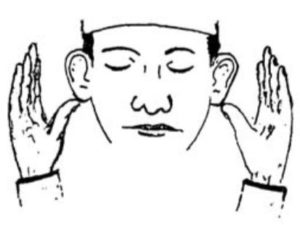
All worshippers do the same. To raise both hands to one’s earlobes when reciting Allahu Akbar is to follow the practice (called the Sunnah) of the Holy Prophet(sa) of Islam. All Muslim schools of thought agree on this. However, there are some Muslim sects who raise their hands to their earlobes more than once in one Rak‘at. Thus, in addition to the moment of saying the first Allahu Akbar at the start of Prayer, they also raise their hands while going to Ruku‘ posture from Standing; when reverting to the standing posture; when going to Sajdah and when getting up from Sajdah. Looking at the history of Islam, we find that the Holy Prophet(sa) did raise his hands more than once during Prayer on several occasions in the early days of his ministry as mentioned in the books of Traditions but this was not his common practice. According to many other Sayings of the Holy Prophet(sa) of Islam he never raised his hands except when saying Takbir-i-Tahrimah in the first Rak‘at of every Prayer. A Companion of the Holy Prophet(sa) Hadrat ‘Abdullah ibn Mas‘ud(ra) is reported to have stated:
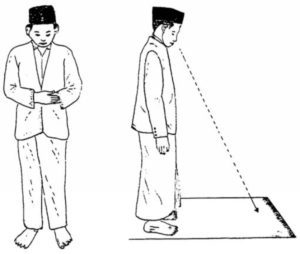
Let me show you how the Holy Prophet(sa) of Islam used to offer his Prayer.‘Abdullah then offered his Prayer and raised his hands only in the beginning when saying Takbir-i-Tahrimah.
After raising his hands to the lobes of his ears and reciting Allahu Akbar, the Imam lowers his hands and folds them on his chest so that the right arm is over his left arm. The worshipper stands before his Lord, an attitude of utmost humility. His hands folded on his chest most respectfully is called the Qiyam, the Standing Posture. However, there are variations in this posture. Some people fold their arms a little lower than the navel while others slightly above the navel and some even a little higher. These are all signs of respect. One should not be so petty minded as to quarrel with others regarding these minor matters. It should also be noted that generally, the Maliki among the Sunnis and the Shia do not fold their arms at all. They leave them straight by their sides. Though no Hadith is available to prove that the Holy Prophet(sa) ever did so, yet no one has the right to object and say that the Prayers of such people who do not fold their arms are not valid. After saying Takbir-i-Tahrimah, the following glorification called Thana’ is recited individually in silence:
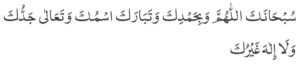
Transliteration:
Subhanakallah-humma wa bihamdika wa tabarakasmuka wa ta‘ala jadduka wala ilaha ghairuk.
Translation:
Holy art Thou, O Allah, and all praise is Thine; blessed is Thy name, and exalted is Thy state. There is none worthy of worship except Thee alone. (Tirmidhi, Kitabus-Salat, Ma Yaqulu inda iftahis-Salati; Sunan Nasa’i, Kitabul-Iftah, Babudh-Dhikr bainas-Salat wa bainal-Qira’at.)
It is also reported in some Sayings that sometimes, the Holy Prophet(sa) of Islam used to recite other verses in place of this glorification but this is the one which is well-known and often recited. The above glorification is followed by Ta‘awwudh, which is also recited silently:

Transliteration:
A‘udhu billahi minash-shaitanir-rajim.
Translation:
I seek refuge with Allah from Satan, the accursed.
After Ta‘awwudh, Bismillah is recited either silently or loudly, by the Imam. The congregation, however, recites it silently. Tasmiyah is as follows:
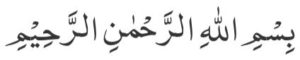
Transliteration:
Bismillahir-Rahmanir-Rahim.
Translation:
In the name of Allah, the Gracious, the Merciful.
According to the Traditions, on some occasions, the Holy Prophet(sa) used to say Tasmiyah aloud while on other occasions he recited it silently. Among Muslims, it is generally recited aloud in Arab countries while the Hanafi sect and a large number of other Muslims recite it silently.
The Imam then recites Surah Al-Fatihah. In certain Prayers, e.g., Fajr, Maghrib and ‘Isha’ Prayers, he recites it loudly, while in others, Zuhr and ‘Asr he and other worshippers, following him, recite it silently. When the Imam is reciting Surah Al-Fatihah loudly, the other worshippers should repeat it silently, verse by verse, during the short interval between the verses after the Imam has recited those verses.
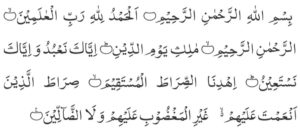
Transliteration:
Bismillahir-Rahmanir-Rahim. Al-hamdu lillahi Rabbil ‘alamin. Ar-rahmanir-Rahim. Maliki yaumiddin. Iyyaka na‘budu wa iyyaka nasta‘in. Ihdinas-sirat al-mustaqim. Siratalladhina an‘amta ‘alai-him, ghairil maghdubi ‘alaihim wa lad-dallin.
Translation:
In the name of Allah, the Gracious, the Merciful. All praise belongs to Allah, Lord of all the worlds, The Gracious, the Merciful, Master of the Day of Judgment. Thee alone do we worship and Thee alone do we implore for help. Guide us in the right path — The path of those on whom Thou hast bestowed Thy blessings, those who have not incurred Thy displeasure, and those who have not gone astray.
At the end of Surah Al-Fatihah, the worshippers say Amin which means ‘O Allah! Accept our supplications.’
The members of the Maliki, Shaf‘i and Hanbali sects of Islam say Amin loudly while the members of the Hanafi sect say it silently. Both forms are admissible. This is not one of those matters which makes Salat valid or invalid. One can adopt whatever method one likes, i.e. to say it aloud or to say it silently. No one else should have the right to object, except when someone says it so loudly that other worshippers are disturbed. Thereafter, the Imam recites a portion of the Holy Quran, at least three verses or a short chapter. For example:
SURAH AL-KAUTHAR
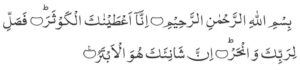
Transliteration:
Bismillahir-Rahmanir-Rahim. Inna a‘atainakal- Kauthar. Fasalli lirabbika wanhar. Inna shani’aka huwal abtar.
Translation:
In the name of Allah, the Gracious, the Merciful. Surely We have given thee abundance of good; So pray to thy Lord, and offer sacrifice. Surely, it is thy enemy who is without issue.
SURAH AL-IKHLAS
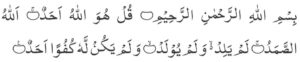
Transliteration:
Bismillahir-Rahmanir-Rahim. Qul huwallahu Ahad. Allahus-Samad. Lam yalid, walam yulad. Walam yakullahu kufuwan ahad.
Translation:
In the name of Allah, the Gracious, the Merciful. Say, He is Allah, the One; Allah, the Independent and Besought of all. He begets not, nor is He begotten; And there is none like unto Him.
SURAH AL-FALAQ
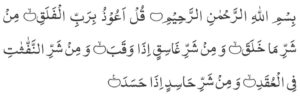
Transliteration:
Bismillahir-Rahmanir-Rahim. Qul a‘udhu birabbil falaq. Min sharri ma khalaq. Wa min sharri ghasiqin idha waqab. Wa min sharrin-naffathati fil-‘uqad. Wa min sharri hasidin idha hasad.
Translation:
In the name of Allah, the Gracious, the Merciful. Say, I seek refuge in the Lord of the dawn, From the evil of that which He has created, And from the evil of the night when it overspreads, And from the evil of those who blow into knots to undo them, And from the evil of the envier when he envies.
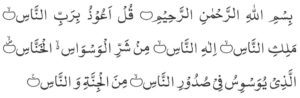
SURAH AN-NAS
Transliteration:
Bismillahir-Rahmanir-Rahim. Qul a‘udhu birabbin- nas, Malikin-nas, Ilahin-nas, Min sharril waswasil khannas. Alladhi yuwaswisu fi sudurin-nas, minal jinnati wan-nas.
Translation:
In the name of Allah, the Gracious, the Merciful. Say, I seek refuge in the Lord of mankind, The King of mankind, The God of mankind, From the evil of the sneaking whisperer, Who whispers into the hearts of men, From among the Jinn and mankind.
These few Surahs of the Quran which we have stated above are only a sample. The Imam may choose any portion of the Quran to recite after the Surah Al-Fatihah.
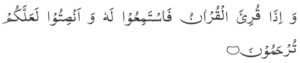
When the Imam is reciting a portion of the Holy Quran, the worshippers are required to listen to it silently. The Holy Quran says:
Translation:
And when the Quran is recited, give ear to it and keep silence, that you may be shown mercy. (7:205)
A Companion of the Holy Prophet(sa) Hadrat ‘Ibadah ibn Samit(ra), relates that once the Holy Prophet(sa) while leading the Fajr Prayer, found it too difficult to recite the verses of the Quran because of the murmur at the back. When he finished his Prayer, the Holy Prophet(sa) asked his Companions whether they were reciting the verses of the Quran after him. Their reply was in the affirmative at which the Holy Prophet(sa)said:
Do not recite the verses of the Quran after the Imam, except the recitation of Surah Al-Fatihah as Surah Al-Fatihah is an integral part of the Salat.
It is essential that every member of the congregation takes care not to cause disturbance to other worshippers and therefore Muslims should take note of the above mentioned Hadith of the Holy Prophet(sa) of Islam.
At the end of the recitation, the Imam goes from the Standing position to the Bowing position, Ruku‘, by calling out Allahu Akbar.
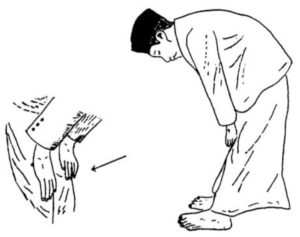
The other worshippers follow him into the Bowing position. In this posture, the right hand of the worshipper should press the right knee and the left hand the left knee, and the upper half of the body from the waist to the head is kept level and horizontal to the ground.
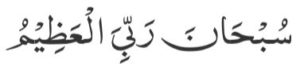
In the Bowing posture the following Tasbih is recited silently three times or more in odd numbers:
Transliteration:
Subhana Rabbiyal ‘Azim.
Translation:
Holy is my Lord, the Most Great.
The Imam then straightens up and stands with his arms by his sides. When he initiates this movement, he recites Tasmi‘ loudly which is an indication for the congregation to change the posture from Bowing to Standing.
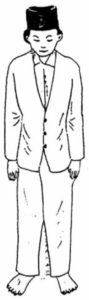
The Tasmi‘ is recited as follows:
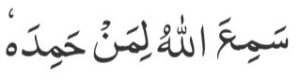
Transliteration:
Sami‘allahu liman hamidah
Translation:
Allah listens to him who praises Him.
In response the congregation follows the Imam and changes posture as well, and then recite the following which is called Tahmid:

Transliteration:
Rabbana walakal-hamd, hamdan kathiran Tayyiban Mubarakan fih.
Translation:
Our Lord, Thine is the praise, the praise which is bountiful, pure and blessed.
This position of standing erect ends with the recitation of Tahmid.
Then the Imam says Allahu Akbar loudly again and leads the congregation into the Prostration position called Sajdah, knees on the ground, then the head.
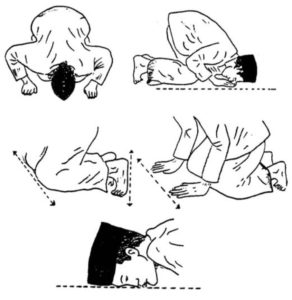
In this posture, the knees, hands, nose and the forehead of the worshipper should be touching the ground. The head should be placed on the ground between the two hands. The arms should be away from the ground and away from one’s sides. The Holy Prophet(sa) has said:
When you prostrate before God, you should place your limbs on the ground in the correct manner. In no way should you spread your arms on the ground like the front legs of a dog when it sits. (Musnad Ahmad bin Hanbal, vol. III, p.279; Al-Maktabah-Islami, Tab‘a wan-Nashr, Beirut..)
The fingers are held together pointing towards the Ka‘bah. The feet should be planted on the ground so that the toes are bent in the direction of the Ka‘bah.
In this posture the Tasbih given below should be recited silently three times at least. If the worshipper wishes to recite it more than three times, he should make sure that the number of recitations are odd and not even:
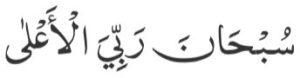
Transliteration:
Subhana Rabbiyal-a‘la.
Translation:
Glory to my Lord, the Most High.
Prostration is a posture of utmost humility, submission and helplessness in which a supplicant pours his heart before God Almighty and asks for His forgiveness.
It should also be noted that during the Ruku‘ and Sajdah, the Holy Prophet(sa) has forbidden the recitation of any Quranic verse. (Sahih Muslim, Kitabus-Salat, Babun Manahi an Qira’til-Quran fir-ruku‘ was-sujud.)
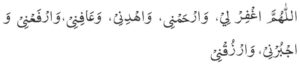
The Imam then says Allahu Akbar again, at which he and the congregation raise their heads and then their hands from the ground and go into the Sitting position called Jilsah. When sitting in this position, the worshipper spreads his left foot horizontally on the ground and rests on it while his right foot is placed on the ground in a perpendicular position, with the toes facing the Ka‘bah. The hands are placed on the thighs with the fingers pointing towards the Ka‘bah, very close to the knees. In this position, the following supplication is recited silently:
Transliteration:
Allahum-maghfir li warhamni wahdini wa ‘afini warfa‘ni wajburni warzuqni.
Translation:
Lord forgive me and have mercy on me and guide me and grant me security and raise me up and make good my shortcomings and provide for me.
After Jilsah, the Imam leads the congregation into a second Prostration by saying Allahu Akbar and, again Subhana Rabbiyal A‘la is done three times or, if more, in odd number. In every Rak‘at of Prayer there are always two Prostrations. At the end of the second prostration, one Rak‘at of Prayer is completed. After saying Allahu Akbar once again, the Imam leads the congregation into the Standing posture to commence the second Rak‘at which is offered exactly as the first Rak‘at.
However, during the second Rak‘at, Thana’ (Glorification) and Ta‘awwudh are not recited. Thana’ and Ta‘awwudh are recited only in the first Rak‘at of every Prayer. The Imam recites Surah Al-Fatihah and then some verses of the Holy Quran and completes the Rak‘at in the same manner as the first. After the second Prostration, he sits down in the same manner as he sat in the position called Jilsah.
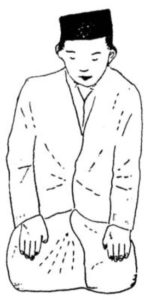
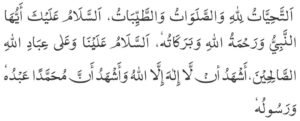
This Sitting Position, at the end of the second Rak‘at is called Qa‘dah. During this position Tashahhud is recited silently, which is as follows:
Transliteration:
Attahiyyatu lillahi was-salawatu wat-tayyibatu, Assalamu ‘alaika ayyuhan-Nabiyyu wa Rahmatullahi wa Barakatuh, Assalamu ‘alaina wa ‘ala ibadillahis-Salihin. Ashhadu alla ilaha illallahu wa ashhadu anna Muhammadan ‘abduhu wa Rasuluh.
Translation:
All Salutation is due to Allah and all Prayer and everything pure. Peace be upon thee, O Prophet, and the mercy of Allah and His blessings; and peace be on us and on all righteous servants of Allah. I bear witness that there is none worthy of worship except Allah, and I bear witness that Muhammad is His servant and Messenger.
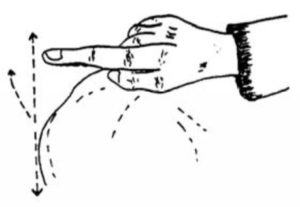
It should be noted that while reciting Tashahhud, when the worshipper reaches the phrase Ashhadu alla ilaha illallahu, he should raise the forefinger of his right hand and should drop it down as he has recited it. It is written in the Books of Traditions that the Holy Prophet(sa) used to close the fingers of his right hand leaving the thumb and the forefinger free, placing the hand on the right knee and raising the forefinger while reciting Ashhadu alla ilaha illallahu and dropping it to its original position as soon as he had recited it. The fingers of the left hand would remain straight on his left knee.
After reciting Tashahhud, the invocation of blessings on the Holy Prophet(sa) called Durud (Assalatu-‘alan-nabi) and some other prayers are recited silently.
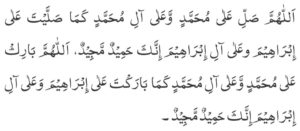
Durud (Assalatu ‘Alan-Nabi)
Transliteration:
Allahumma salli ‘ala Muhammadin wa ‘ala ali Muhammadin kama sallaita ‘ala Ibrahima wa ‘ala ali Ibrahima innaka Hamidum-Majid. Allahumma Barik ‘ala Muhammadin wa ‘ala ali Muhammadin kama Barakta ‘ala Ibrahima wa ‘ala ali lbrahima innaka Hamidum-Majid.
Translation:
Bless, O Allah, Muhammad and the people of Muhammad, as Thou didst bless Abraham and the people of Abraham. Thou art indeed the Praiseworthy, the Glorious. Prosper, O Allah, Muhammad and the people of Muhammad, as Thou didst prosper Abraham and the people of Abraham. Thou are the Praiseworthy, the Glorious.
The invocation Durud (Assalatu‘alan-nabi) is followed by a short prayer or prayers, some of which are given below:

Transliteration:
Rabbana atina fiddunya hasanatan wa fil akhirati hasanatan waqina adhabannar. (2:202)
Translation:
Our Lord, grant us good in this world as well as good in the world to come, and protect us from the torment of the Fire.

Transliteration:
Rabbij‘alni muqimas-Salati wamin dhur-riyyati. Rabbana wa taqabbal du‘a’. Rabbanaghfir li wali- walidayya wa lil-mu’minina yauma yaqumul hisab. (14:41-42)
Translation:
My Lord, make me observe Prayer, and my children too. Our Lord! bestow Thy grace on me and accept my prayer. Our Lord, grant forgiveness to me and to my parents and to the believers on the day when the reckoning will take place.
Transliteration:
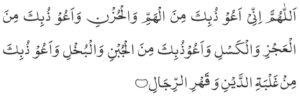
‘Allahumma inni a‘udhu bika minal-hammi wal- huzni, wa a‘udhu bika minal ‘ajzi wal kasli, wa a‘udhu bika minal jubni wal-bukhli. Wa a‘udhu bika min ghalbatid-daini wa qahrir-rijal. (Sunan Abu Dawud, Kitabus-Salat).
Translation:
O Allah, I seek Thy protection against problems and anxieties, and I seek Thy protection against helplessness and shiftlessness, and I seek Thy protection against cowardice and miserliness, and I seek Thy protection against indebtedness and the tyranny of people.
Transliteration:
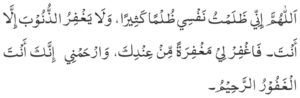
Allahumma inni zalamtu nafsi zulman kathiran, wa la yaghfirudh-dhunuba illa anta, faghfir li maghfiratan min ‘indika warhamni innaka antal Ghafurur-Rahim.
Translation:
O Allah, I have been unjust to myself and no one grants pardon for sins except You; therefore, forgive me with Your forgiveness and have mercy on me. Surely You are the Forgiver, the Merciful.
Transliteration:
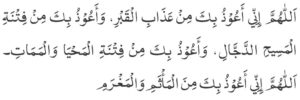
Allahumma inni a‘udhu bika min ‘adhabil-qabri wa a‘udhu bika min fitnatil-masihid-dajjal. Wa a‘udhu bika min fitnatil mahya wal mamat. Allahumma inni a‘udhu bika minal ma’thami wal maghram.
Translation:
O Allah, I seek Thy protection from the punishment of the grave, and I seek Thy protection against Dajjal, the architect of disorder and trials, and I seek refuge with You from afflictions of life and death. O Allah, I seek Thy protection from sins and from being in debt.
After reciting one or more of these prayers, the Imam turns his face towards the right and says Assalamu ‘Alaikum wa Rahmatullah, i.e. peace be upon you and the mercy of Allah, and then turns his face towards the left and repeats Assalamu ‘Alaikum wa Rahmatullah, to mark the end of the Prayer.
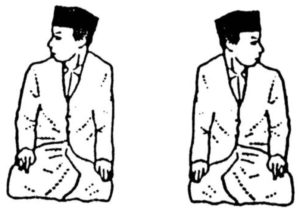
The congregation does the same. If the Prayer which is being performed is not of two Rak‘at but is a three or four Rak‘at Prayer, then sitting in the Qa‘dah position at the end of the second Rak‘at, is shortened and the worshipper recites only up to and including Tashahhud. Having recited Tashahhud, the Imam says Allahu Akbar indicating the end of the second Rak‘at and the beginning of the third Rak‘at, and assumes the Qiyam posture, completes the third Rak‘at exactly as he has done the second. The whole congregation follows him. If the Prayer is of three Rak‘at, for example Maghrib Prayer, then after the second prostration of the third Rak‘at, the Imam sits in the Qa‘dah position, recites Tashahhud and Durud and some other prayers silently and says Assalamu ‘Alaikum wa Rahmatullah, marking the end of the Prayer. The whole congregation follows his movements and recite the same silently.
If the Prayer is a four Rak‘at Prayer, like Zuhr, ‘Asr and ‘Isha’, the Imam does not assume the Qa‘dah posture at the end of the third Rak‘at, but leads the congregation immediately into the Qiyam of the fourth Rak‘at. It is only after the second Prostration of the fourth Rak‘at that the Imam sits in the Qa‘dah position. In this Qa‘dah which is called final Qa‘dah, recite Durud and prayers after Tashahhud. They then end the Prayer by saying Assalamu ‘Alaikum wa Rahmatullah while turning their face towards the right and to the left as explained earlier. The following points should be noted:
-
If it is the final Qa‘dah, Tashahhud and Durud and some other prayers are recited. If it is not the final Qa‘dah, only Tashahhud is recited and after saying Allahu Akbar the next Rak‘at is started.
-
If the Prayer being performed is a two Rak‘at Prayer, the Qa‘dah after the second Rak‘at is the final Qa‘dah.
-
If it is a three Rak‘at Prayer, the Qa‘dah at the end of the third Rak‘at is the final Qa‘dah.
-
If it is a four Rak‘at Prayer the Qa‘dah at the end of the fourth Rak‘at is the final Qa‘dah.
Individual Prayer
Even if Prayer is not offered in congregation but offered individually, it is offered exactly in the same way as when led by an Imam, except that whatever the Imam recites loudly, is not recited loudly by the individual worshipper. He recites everything silently, without raising his voice. For example, when he recites Surah Al-Fatihah, or says Allahu Akbar, Sami‘allahu liman Hamidah and Assalamu ‘Alaikum, he recites all of these silently.
Congregational Prayer
Every Muslim is required to offer the Fard part of his Prayers in congregation. Mosques are built for the purpose of congregational Prayers. A Hadith tells us that the reward of a Prayer offered in congregation is twenty-seven times more than that offered individually.
The Imam should be chosen by the congregation, keeping in mind that to the best of their knowledge, he is a pious person and the most well-versed among them in the Holy Quran. The Imam can also be appointed if there is a regular religious authority, e.g., a Khalifah. Whoever is chosen or appointed as Imam must be followed in the Prayer even if somebody thinks that the appointed person is not worthy of it. For those people who doubt the worthiness of an Imam, the following instructions of the Holy Prophet(sa) should suffice:
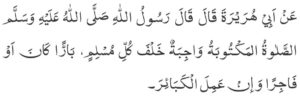
Transliteration:
‘An Abi Hurairah qala Qala Rasulullahi sallallahu ‘alaihi wa sallam: Assalatul maktubatu Wajibatun khalfa kulli Muslimin, barran kana au fajiran wa in ‘amilal kaba’ir. (Sunan Abu Dawud, aljuz’ul-awwal, Kitabus-Salat)
Translation:
Hadrat Abu Hurairah(ra) related that the Holy Prophet(sa) stated: To offer Fard Prayer behind any Muslim Imam is essential, whether he is a pious person or a sinner, even if he had committed a grievous sin.
If, at the prescribed time for any Prayer, two or more men are present away from a mosque, they are required to observe the prayer in congregation. When only two males come together for Prayers, one of them should lead the Prayer. They should stand together so that the 2nd person stands on the right side of the Imam.
If a man performs his Prayer at home and a female member of the family like to join him, then, she should stand on his left. In the case where two men are already offering their prayer in congregation, and worshippers arrive, they should arrange themselves in a row so that the Imam remains in the middle. In normal cases when three or more persons offer their prayer in congregation, the Imam should stand in front, all facing towards the Ka‘bah. In exceptional cases however, the Imam can also stand in the middle of the first row along with other worshippers.
According to some schools of thought, there should be at least two persons in the last row behind the Imam. These schools of jurisprudence even permit gently pulling someone from the last row so as to form a new row with two persons instead of one.
Other schools discourage this act, as it not only causes disturbance to the person who is gently pulled but also to the others who are already engaged in prayer.