Prayer During Sickness
The performance of Salat is of prime importance in Islam. A sick person who cannot stand for Prayer, should offer his Prayer while sitting; and if he cannot even sit, he should offer his Prayer while lying down.
If he cannot bow down or prostrate, he is allowed to make symbolic gestures to that effect, and if he is so sick that he cannot move his head or hand, he can fulfill this obligation by making gestures in his mind.
Prayer During a Journey
If a person is travelling by any means of transportation which precludes his standing up for Prayer, nor can he get off from the vehicle, he can offer his Prayer while seated and the condition of facing towards the Qiblah would not be mandatory in this situation. He should face in the direction in which the mount, vehicle, boat or airplane, etc., is moving, if possible.
In the early days of Islam, the Zuhr, ‘Asr and ‘Isha’ congregational Prayer services had only two Rak‘at, just like Fajr Prayer but subsequently they continued to be of two Rak‘at length only for a person who is on a journey. In normal circumstances, the number of Rak‘at were doubled. Hence, normally, one has to perform four Rak‘at Fard each, for Zuhr, ‘Asr and ‘Isha’ Prayers while a traveller offers only two Rak‘at for each of the above-mentioned Prayers.
If a traveller reaches a place where he intends to stay less than 15 days, then this concession will apply and he will shorten his Prayers as mentioned above.
However, this concession does not apply to the Fard part of the Fajr and Maghrib Prayers.
If a person is staying with a close relative whose house he regards as his own, e.g. his parents’ home, the home of his in-laws, or a religious headquarter such as Makkah, Medina, Qadian or Rabwah, etc., he can shorten his Prayer as outlined above but it would be preferable for him to offer the full four Rak‘at as applicable.
While one is on a journey, the Sunnat part of every Prayer is dropped, with the exception of the Vitr Rak‘at in the ‘Isha’ Prayer and the two Rak‘at Sunnat of the Fajr Prayer.
To offer Nawafil during a journey, i.e. optional Prayers, are entirely up to each individual.
Moreover, it is also permissible to combine two Prayer services during a journey. Zuhr Prayer can be joined with the ‘Asr Prayer and can both be offered either at the Zuhr Prayer time or at ‘Asr Prayer time. Similarly the ‘Isha’ Prayer can be joined with the Maghrib Prayer and can be offered either at Maghrib Prayer time or ‘Isha’ Prayer time.
If travellers are offering their congregational Prayer behind an Imam who is a local inhabitant, they have to follow the Imam and offer four Rak‘at for Zuhr, ‘Asr and ‘Isha’ Prayers. The rule of concession would not apply in that case. But if the person leading the Prayer, i.e. the Imam, is a traveller, then he will shorten his Prayer accordingly and the travellers in the congregation will also finish their Prayer with the Imam, while those who are not on a journey will stand up when the Imam has recited the salutations to mark the end of Prayer and complete their Prayer.
Prayer During Danger (Salatul-Khauf)
It is permissible to shorten one’s Prayer when one is facing life-threatening danger, e.g., war. The act of Qasr, which means shortening of Prayer, can be applied to Prayer in eleven different ways that have been mentioned in the Holy Quran and in the Traditions. In essence, when heavy fighting breaks out in the battlefield, or one anticipates a surprise attack from the enemy, or if the army is forced to take up positions in trenches, Prayers are shortened because of the intensity of the situation. If the situation permits one to offer two Rak‘at, one should offer two Rak‘at, otherwise one Rak‘at would be acceptable. In case it is too dangerous to offer Prayer in congregation, individual Prayers should be offered but if the situation does not allow even this, then one can offer Prayer while on the move, on foot or on a mount, whether or not facing the Qiblah. If the danger is even of a greater degree, the Prayers can be offered through mere gestures, or by declaring the intention to pray and with a few gestures reciting some portion of the prescribed verses. It is also permissible to combine several Prayers at a time during such conditions. (Sahih Bukhari, Kitabul-Maghazi, Bab Ghazwah Khandaq, Sahih Muslim, Kitabus-Salat Bab Salatul-Khauf)
Qada (Missed) Prayers
If one misses the timely performance of a daily Prayer service, e.g., due to forgetfulness, falling asleep, or becoming unconscious, etc., then such missed Prayers, when offered later on, are known as Qada Prayers. One has to offer the obligatory part of the Prayer services which have been missed. Whenever a person realises that he has missed the obligatory Prayers or Prayer, he should offer them immediately keeping in view the natural sequence of those Prayers.
Some religious leaders have given decrees that one may offer one substitute Prayer to compensate all Prayers missed in one’s lifetime. They have coined the term Qada’i ‘Umri for it. Because of such teachings people have become less attentive in the observance of Prayers.
Prayer is the daily sustenance of the spirit. How can a person stay hungry for ten years and then eat ten years’ worth of food in one go? It, therefore, demeans the institution of Prayer to suggest that a person may neglect the duty of offering Prayer all his life and then simply offer Qada’i ‘Umri one day to compensate the loss. This is not the teaching of the Holy Prophet(sa) of Islam.
According to Islamic jurisprudence, if someone has missed a Prayer knowingly and deliberately, no Qada can compensate that and the Prayer is lost for ever, but the true judge in such cases is God Almighty.
Tahajjud Prayer
To go to bed soon after the ‘Isha’ Prayer and to get up in the late hours of the night for the observance of the optional Tahajjud Prayer is a source of great blessing. Although it is not obligatory, it is very strongly emphasised by the Holy Quran. It has always been the practice of the pious people to perform this Prayer regularly in order to gain Allah’s special favours. The time for Tahajjud Prayer finishes when the time for Fajr Prayer starts. The supplications made during Tahajjud Prayer are granted acceptance by God Almighty readily. It is also a vehicle for achieving nearness to God, because at that hour, one gives up sleep and forsakes the comfort of one’s bed, to fall prostrate before one’s Lord. Tahajjud Prayer consists of eight Rak‘at. The Holy Prophet(sa) always offered Tahajjud Prayer, dividing it into two Rak‘at units. He used to recite long passages from the Holy Quran in the Qiyam position and prolong Ruku‘ and Sajdah with supplications. His Tahajjud Prayer was followed by three Rak‘at of Vitr Prayer. Thus he used to offer eleven Rak‘at every night before dawn.
Taravih Prayer
Taravih Prayer is the special Prayer ordained for the month of Ramadan. It has to be performed each night during the month of Ramadan. It is in fact offered at Tahajjud time. The observance of Taravih Prayer after the ‘Isha’ Prayer was allowed during the caliphate of Hadrat ‘Umar(ra), to enable such people, who for unavoidable reasons could not perform Taravih Prayer at Tahajjud time to still offer this Prayer. However, it is preferable to offer this Prayer in pre-dawn hours. The recitation of long passages from the Holy Quran during the Taravih Prayer has been in vogue among Muslims, following the practice of the Companions of the Holy Prophet(sa).
Taravih Prayer consists of eight Rak‘at, but one can offer as many as twenty or more Rak‘at if one wants to. It seems appropriate to take a little rest each time after offering four Rak‘at.
Prayer When Solar and Lunar Eclipses Occur
The solar eclipse is called Kusuf and the lunar eclipse is called Khusuf. This visual change in the heavenly bodies reminds the faithful that just as the sun and the moon appear to have lost their light to a considerable extent during the eclipses, so can various kinds of spiritual ills result in a reduction of the spiritual light that illuminates the believer’s heart. Only God’s mercy can protect one from such a spiritual eclipse. Hence a two Rak‘at Prayer is precribed on the occasion of solar or lunar eclipses as a reminder to believers that they should seek God’s blessings and God’s mercy if they want to scale spiritual heights.
The inhabitants of a town or city offer two Rak‘at in congregation, either in a mosque or outside in the open. Surah Al-Fatihah and long passages from the Holy Quran should be recited aloud in this Prayer. In every Rak‘at, two Ruku‘ are performed. After the recitation of some passages of the Holy Quran, a Ruku‘ should be performed, then the Imam should go back in Qiyam position and recite some other passages from the Quran and then go into Ruku‘ for the second time. Some Traditions even tell us that the Holy Prophet(sa) performed three Ruku‘ in one Rak‘at. Then the Imam should go into Sajdah position. Lengthy supplications should be made in Ruku‘ as well as in Sajdah of this Prayer. At the end of the Prayer, the Imam should deliver a sermon, in which he should draw the attention of people to the subject of asking forgiveness from God Almighty and he should discuss ways and means of reforming society.
Prayer to Invoke Rain
When there is a drought due to lack of rain, people might invite the mercy of God Almighty by gathering in an open field for Prayer, during the day. The Imam should wear a sheet of cloth as his outer garment and lead a two Rak‘at Prayer. The recitation in this Prayer should also be aloud. After the Prayer, the Imam should lead the congregation by raising his hands in Prayer and he should recite the following:
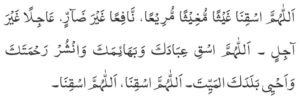
Transliteration:
Allahummasqina ghaitham-mughitham-muri‘an- nafi‘an ghaira dharin, ‘ajilan ghaira ajil. Allahummasqi ‘ibadaka wa baha’imaka wanshur rahmataka wa ahyi baladakal-mayyita. Allahummasqina, Allahummasqina. (Sunan Abi Dawud, Kitabus-Salat; Sunan Nasa’i)
Translation:
O Allah, give us rain, abundant, widespread, producing herbage, benefiting without doing injury, soon, without delay. O Lord send water for Thy servants, and Thy animals, and extend Thy Mercy and revive the land that lies dead. O Lord send us water! O Lord send us water.
Then, the Imam should recite Durud and continue to pray, expressing his humility and extolling the greatness of God. Then he should turn his sheet of cloth inside out. This amounts to a good omen and, in a way, depicts the plight of the people to the Creator, making a plea to Him that as the Imam has overturned his outer garment, God Almighty should accept their supplications and overturn the existing suffering caused by drought.
Istikharah Prayer
It is a Prayer to seek guidance from God Almighty when one intends to embark upon any important task or project, e.g., trade, journey, marriage, etc. The matter may be religious or otherwise. The purpose of this Prayer is also to seek God’s help so that the outcome of the task in hand is successful.
A two Rak‘at Prayer is offered, before one goes to bed at night, in which Surah Al-Fatihah is followed by Surah Al-Kafirun in the first Rak‘at and Surah Al- Fatihah followed by Surah Al-Ikhlas in the second Rak‘at. During Qa‘dah position after reciting Tashahhud and Durud and some other Prayers, the following should be recited:
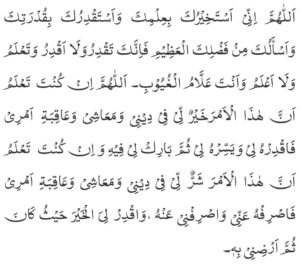
Transliteration:
Allahumma inni astakhiruka bi‘ilmika wa astaqdiruka biqudratika wa as‘aluka min fadlikal ‘azim. Fa innaka taqdiru wala aqdiru, wa ta‘lamu wala a‘lamu wa anta ‘allamul ghuyub. Allahumma in kunta ta‘lamu anna hadhal amra khairun li fi dini wa ma‘ashi wa ‘aqibati amri faqdirhu li wa yassirhu li thumma barik li fih. Wa in kunta ta‘lamu anna hadhal amra sharrulli fi dini wa ma‘ashi wa ‘aqibati amri fasrifhu ‘anni wasrifni ‘anhu, waqdir liyal- khaira haithu kana thumma ardini bih.
Translation:
O Allah, I seek good from Thee out of Thy knowledge and seek power from Thee out of Thy power and I beg of Thee out of Thy boundless Grace, for Thou hast power and I have no power, and Thou hast knowledge and I have no knowledge, and Thy knowledge encompasses the unseen.
O Allah! If it be within Thy knowledge that this task is for my good, both materially and spiritually, and in respect of my ultimate end, then make it possible for me and bless me therein, but if it be within Thy knowledge that it is harmful for me in my spiritual and material life and in respect of my ultimate end, then turn me away therefrom, and enable me to attain good wherever it may be and cause me to be blessed therewith. (Bukhari, Kitabud-Da‘wat Babud-Du’a indal Istikharah; Also Tirmidhi; Sharah As-Sunnah Vol. 4, page 153).
This sequence of Prayer recitation is derived from the practice of the Holy Prophet(sa).
Salatul-Hajjat, i.e. Prayers Offered When in Need of Help
This Prayer is performed when one is in need or in difficulty. The Holy Prophet(sa) said that whoever is in need of something, should perform Wudu’ and then say two Rak‘at of Prayer. After the Prayer, one should recite Thana’ or glorification and praise of God Almighty, Durud and then recite the prayer given below. It is hoped that the particular need will be fulfilled and God would show the way for the achievement of that goal.
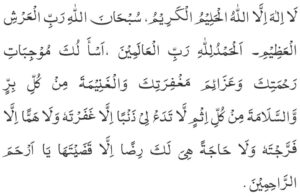
Transliteration:
La ilaha illallahul Halimul Karim, subhanallahi Rabbil ‘arshil ‘azim. Alhamdu lillahi Rabbil ‘alamin. As’aluka mujibati rahmatika wa ‘aza’ima maghfiratika, wal ghanimata min kulli birrin was- salamata min kulli ithm. La tada‘ li dhamban illa ghafartahu wa la hamman illa farrajtahu wa la hajatan hiya laka ridan illa qadaitaha ya Arhamar- Rahimin.
Translation:
There is none worthy of worship except Allah. He is the Compassionate, the Kind. Allah is free of all blemishes and holds the great Heavenly Throne. All praise belongs to Allah alone, Lord of the worlds. Lord! I seek from Thee the instruments of Thy Mercy and the ways and means of Thy forgiveness. I implore Thee to grant me abundantly from Thy virtue and I beg Thee to keep me away from every sin. O Most Merciful God! Eliminate all my sins by forgiving them, and all my grief by dispelling it, and fulfil all my needs which Thou art pleased with.
Ishraq Prayer
This Nawafil (optional) Prayer consists of two phases; offering two Rak‘at when the sun has risen for a while but not enough to have heated up the environment. Once the latter has occurred, this is the second phase, in which one may offer four or eight Rak‘at. The first phase is known as Salatul-Ishraq and the second Salatud-Duha. It has also been named Salatul-Awwabin.
In some Traditions, however, the six Rak‘at Prayer offered in between Maghrib and ‘Isha’ Prayers is called Salatul-Awwabin.
Funeral Prayer
When it seems that someone is approaching his time of death, the recitation of Surah Ya Sin (Ch. 36 of the Holy Quran) is recommended. The reason for this choice is that the topics dealt with in this Surah are of a nature which alleviate the suffering of the person concerned and give him a kind of spiritual comfort. One should also recite, in low but audible tone, the Takbir, and Kalimah Shahadah near the person concerned. Once the person dies, all those who are present and all who come to know of the death later, should recite:
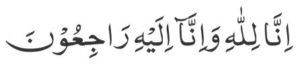
Transliteration:
Inna lillahi wa inna ilaihi raji‘un.
Translation:
Indeed we are for Allah and it is to Him that we return.
The eyes of the deceased should be closed by hand and a cloth band should be used round his chin and head so that his mouth is closed. Instead of bewailing, one should remain calm and patient and attend to the funeral and burial arrangements.
The body should be bathed in the following manner:
Fresh or lukewarm water should be used to wash the body three times. The practise of the Holy Prophet(sa) was to put some leaves of a Beri tree in the water for washing the dead body. First of all, those limbs, which are washed during normal Wudu’ (Ablutions) should be washed though it is not required to pour water in the mouth or nostrils to clean them or to wash the feet. Next the body should be washed, first the right side and then the left. Private parts of the body should remain covered by a cloth. Men alone can bathe male persons and women alone can bathe female persons. The body should then be wrapped in a shroud, which normally is made of an inexpensive white cloth.
The shroud for men consists of three pieces of cloth; a top sheet to cover the top part of the body, a bottom sheet to cover the lower part and a large sheet to cover the whole body from head to feet.
For a female, however, two additional pieces of cloth are used, one for her chest and the other for her head. Islam instructs that one should arrange the burial with utmost simplicity.
A martyr does not need either bathing or the shroud to wrap his body. He should be buried in the clothes he was wearing at the time of death.
After bathing and wrapping the body in a shroud, the body should be carried on shoulders to the place where the Funeral Prayer is to be performed. The Funeral Prayer is held in the open or in a place built for that purpose called Janazah Gah. Those present for the funeral service should arrange themselves in rows behind the Imam. The number of rows should be odd. The Imam should occupy a position ahead of the first row and in the middle, with the body of the deceased resting in front of him. The position of the dead body should be such that the right side of the body should be towards the Ka‘bah.
The Imam commences the Prayer by saying Allahu Akbar, i.e. Allah is the Greatest, loudly. The followers say the same in a low tone. The Imam then recites Thana’ and Surah Al-Fatihah silently. He then says Allahu Akbar without raising his hand. The followers say Allahu Akbar too, but in a low tone.
Then, the whole congregation recites Durud silently. After that the Imam says Allahu Akbar for the third time audibly and the particular prayers for the deceased as given below, are recited. The Imam then says Allahu Akbar for the fourth time and, turning his face towards the right says Assalamu ‘Alaikum wa Rahmatullah, and turning his face towards the left repeats the same to mark the end of the Prayer.
The followers, too, say Assalamu ‘Alaikum wa Rahmatullah, in a low tone and also turn their faces to the right and left.
There is no Ruku‘ or Prostration in the Funeral Prayer. Funeral Prayer in absentia can also be offered for a deceased person, specially for prominent people or in a case when few Muslims have offered the original Funeral Prayer. To offer a Funeral Prayer for a Muslim is obligatory for the body of all Muslims. It is called Fard-i-Kifayah. Thus if only a few people offer the Funeral Prayer they are deemed to have done it on behalf of all Muslims. The rest of the Muslim Community is therefore absolved from the obligation of performing the Funeral Prayer.
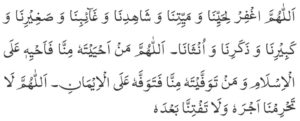
If the deceased is an adult, male or female, the following Prayer is recited:
Transliteration:
Allahumaghfir lihayyina wa mayyitina wa shahidina wa gha’ibina wa saghirina wa kabirina, wa Dhakarina wa unthana. Allahumma man ahyaitahu minna fa’ahyihi ‘alal-Islam, wa man tawaffaitahu minna fatawaffahu ‘alal-Iman. Allahumma la tahrimna ajrahu wala taftinna ba‘dah.
Translation:
O Allah, forgive our living ones and our deceased ones and those of us who are present and those who are absent, and our young ones and our old ones and our males and our females. O Allah, those of us whom Thou grantest life, keep them firm on Islam, and those of us whom Thou causest to die, cause them to die in the faith. Deprive us not, O Allah, of the benefits relating to the deceased and subject us not to trial after him. (Ibn-e-Majah Kitabul-Jana’iz, Babud-Du‘a’ fis-Salati ‘alal janazah, page 107).
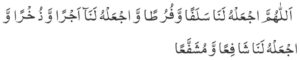
Prayer for a Deceased Male Child
Transliteration:
Allahummaj‘alhu lana salafan wa furutan, waj‘alhu lana ajran wa dhukhran, waj‘alhu lana shafi‘an wa mushaffa‘a.
Translation:
O Allah make him our forerunner, and make him, for us, a reward and a treasure, and make him for us a pleader and accept his pleading.
Prayer for a Deceased Female Child

Transliteration:
Allahumaj‘alha lana salafan wa furutan wa dhukhran wa ajran wa shafi‘atan wa mushaffa‘ah.
Translation:
O Allah make her our forerunner, and make her, for us, a reward and a treasure, and make her for us a pleader and accept her pleading.
After the Funeral Prayer, the body should be taken to the cemetery for burial without any delay. The coffin should be carried on shoulders and all those who accompany the coffin should take turns in shouldering the coffin. If the body is to be carried to a considerable distance for burial, a vehicle may be used. Those who follow the funeral procession should continue the remembrance of God as well as pray for the forgiveness of the deceased in a low tone.
The grave may be prepared either as a dug up area which contains a further niche (lahd) inside for the body to rest on or it may be just a dug up area. However, it is essential for the grave to be wide and spacious. In extreme cases more than one body can be buried in one grave. If the burial at a particular location is meant to be temporary, or if the burial ground is likely to be affected by flood waters, then it is permissible to use an iron or wooden box for the corpse so as to protect the body from decaying too early.
The body must be lowered into the grave with care and caution.
The following should be recited when the body is being lowered into the grave:

Transtiteration:
Bismillahi wa billahi ‘ala millati Rasulillahi sallallahu ‘alaihi wasallam.
Translation:
In the name of Allah and with his blessings, upon the path set by the conduct of the Messenger of Allah, peace be upon him.
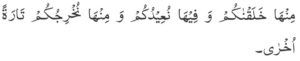
As the body is placed in the grave, the sheet wrap should be loosened a bit at the opening and the face tilted a little towards the Qiblah. Some bricks or stone slabs should be used to cover the niche (lahd) and then sand or loose earth should be heaped. The following should be recited on this occasion:
Transliteration:
Minha khalaqnakum wa fiha nu‘idukum wa minha nukhrijukum taratan ukhra.
Translation:
We have created you out of this (dust) and we shall return you to it and it is out of the same that we shall revive you in the end.
It is in keeping with the practice of the Holy Prophet(sa) to make the heap of the grave somewhat raised from the ground, i.e. a slight hump-like form.
When the burial ceremony is complete, a brief silent congregational Prayer with raised hands should be made for the forgiveness of the deceased. Then the mourners should leave the cemetery reciting the following:

Transliteration:
Assalamu ‘alaikum wa inna insha’allahu bikum la-lahiqun.
Translation:
Peace be upon you and God willing we are certainly bound to join you.
Condolences must be offered to those related to the deceased.
It is commendable for the near and dear ones, or neighbours, to provide meals to the bereaved family for one time at least.
One must not give in to any superstitions. The condolences and conditions of bereavement should be maintained for three days. After that life should come back to normal. However, the period of bereavement as applicable to the widow of the deceased is four months and ten days. According to the Holy Quran, this is a period to stabilise her mentally and emotionally as women are under a great stress, more so than men in this situation, and they need protection from those who sometimes exploit their helplessness by sympathising at the time when such women are more vulnerable. During this period, a widow should not leave her house except for unavoidable needs. In case the woman is the only earning hand in the family and she has to keep up her job obligations, then she is allowed to go out for the purpose of performing her essential professional responsibilities, without socialising herself.
She may further abstain from wearing make-up, dressing up festively, using perfume or taking part in festive ceremonies. This period should be spent by her in the remembrance of Allah and with patience and gratitude to her Creator.