The issue of destiny is a very complicated one, which has been debated through the ages by philosophers and divines alike. In almost every religion there is some reference to the nature of destiny.
We can divide those who believe in destiny into two major categories. Those with the commonly held blind belief in destiny portray it as predetermination by God of everything big and small. This view is popular with some cryptic sects of Sufis (mystics), who live a life apart from the common people. They claim that man has no control over anything. Everything is predetermined. As such all that happens is the unfolding of the grand plan of destiny, known only to God. This is a very problematic concept of the plan of things and inevitably leads to the question of crime and punishment, penalty and reward. If a man has no choice, then there should be neither punishment nor reward for his actions.
The other view is that of free choice, with destiny playing practically no role in whatever man decides and executes.
During the discussion on destiny, another important philosophical issue finds its way into the debate adding further complications, and that is the question of pre-cognition. What does the pre-knowledge of God have to do with the things to come? That is the question, the answer to which has been rather poorly handled by both parties in the debate. We do not propose to enter into a lengthy review of the comparative merits of the arguments of the believers and unbelievers of destiny, but would only attempt to portray the Islamic viewpoint.
Destiny has many categories, each playing a distinct role in their respective spheres of operation, working simultaneously. The laws of nature reign supreme and none is above the influence of them. This is the general plan of things which can be referred to as the widest concept of destiny. Whoever follows the laws of nature with a profound understanding of them will gain some advantage over others who do not. Such people are always destined to benefit and to shape a better life for themselves. But none of them is predestined to belong to any specific grouping in relation to their being on the right or wrong side of the laws of nature.
There was a time in the era just preceding the Renaissance in Europe, when the Muslim world of the orient was far more advanced in its understanding of the laws of nature. The Muslims consequently were in a position to draw benefits attendant upon this knowledge. When, later on, this unprejudiced and open minded study of nature shifted to the West, it ushered in a new day of light of knowledge for the West while the East began to plunge into a long, dark night of wishful thinking, superstition and dreaming. This is destiny of course, but of a different type. The only law which is predetermined in relation to this destiny is the unchangeable command that whoever studies nature without prejudices, and permits himself to be led to wherever the laws of nature would lead him, he would tread the path of eternal progress. This is the general and all-pervasive category of destiny which transcends everything, except the laws of destiny relating to religion.
Before taking up the discussion of destiny in application to religion, we should further explore some areas of this universal destiny of the laws of nature. In their larger global applications, they exhibit some features of predetermination but of a different type than commonly understood. In this sense we are speaking of such seasonal or periodic changes in atmospheric balances which represent a very complicated eco-system in which even distant events such as sun spots play a role. Similarly, the meteoric invasions of planets bring about certain changes, which are reflected upon the earth through corresponding variations in weathers, climates etc. These larger influences, together with periodic alterations in climates (which are caused by various factors many of which are as yet undetermined), sometimes bring about subtle changes in the growth patterns of vegetative and animal life on earth. Again there are factors responsible for droughts or shifting of seasons from one part of the earth to another. Ice-ages and global warming, in alternation, are but some consequences of various cosmic influences. However, these larger influences do not specifically affect an individual’s life on earth, but in the final analysis, as individuals are all members of the Homo-Sapiens family, they are affected to a degree.
There is no evidence to indicate that each man’s life is pre-ordained, and that he has no choice or option in choosing between good and bad, right and wrong. The Holy Quran categorically rejects the concept of compulsion, and clearly states that every human being is free to choose between good and evil:
 There shall be no compulsion in matters of faith. (Quran 2:257)
And:
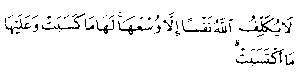 Allah burdens not any soul beyond its capacity. It shall have the reward it earns, and it shall get the punishment it incurs. (Quran 2:287)
And again:
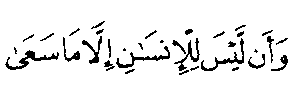 And that man will have nothing but what he strives for. (Quran 53:40)
However, in relation to religion, there are some spheres of destiny which are predetermined and unchangeable. They are referred to in the Holy Quran as the Sunnah of God. One such Sunnah is the destiny that God’s messengers will always be victorious, whether they are accepted or not. If they are rejected, it is the opponents whose designs are frustrated. The prophets, their messages and mission must always prevail, regardless of how powerful their enemies may be a few examples in the living history of man are the confrontations between Moses(as) and Pharoah, between Jesus(as) and his opponents, and between Muhammad(sa)and his adversaries. The triumph of religion is what remains as the legacy of past struggles between prophets and their adversaries. Abraham(as) and his faith, and those who uphold him and his message, predominate the world. Moses(as) and those who revere him, Jesus(as) and his message, and the Prophet Muhammad(sa) and what he stood for, almost dominate the entire world. But none is found today who uphold the cause and values of their opponents. This destiny does not come into play in other confrontations between men and men. The general rule there is that the strong will annihilate the weak. In religious destiny, it is the converse which becomes an inviolable principle.
Although the laws of nature run a smooth course and one does not normally find exceptions to the general rules, but according to the plan of things inferred from various verses of the Quran, the laws of nature known to us belong to many categories and spheres. They do not clash with each other within their spheres, but when they stand at cross-purpose with other laws, the laws which possess greater force always prevail over the weaker ones. Even a law of the widest and farthest influence can be defeated within a small sphere by a more powerful one operating against it. Thermodynamic and electromagnetic laws in opposition to the laws of gravitation can win in limited areas of influence. However, the gravitational law is much wider in its influence, and more far-reaching. As man’s understanding of nature develops from age to age, things which would have been rejected as impossible are becoming conceivable and matters of commonplace observation.
In view of this introduction, according to Islam, if God decides to favour a special servant of His with a special manifestation of some hidden laws, such manifestations are regarded by the onlookers as miracles and supernatural events. But these things happen in accordance with the laws of nature, which are subtly controlled to bring about an amazing effect. Here, destiny plays a specific role in the life of a special servant of God.
Similarly, destiny can also be understood in relation to the genetic, social, economic or educational background of the individual, who seems to be a helpless product of circumstances. This helplessness of the individual makes his destiny, over which he has no control. Thus it is said that a rich man’s child is born with a silver spoon in his mouth.
The circumstances in which a person is born, the society in which he is reared, the day-to-day game of chance which plays a role in everybody’s life, the strikes of so-called luck in favour or against one, the accidents which one may escape or fall prey to, are all areas where the individual has very little choice. Yet it may not be assumed that he was particularly targeted for such events or accidents which play an important role in the making or unmaking of his life.
Individuals who are born in homes riddled with poverty are far more likely to fall prey to petty or even serious crimes. Poverty is the most compulsive force of all factors which create and promote crime. If this is understood to be destiny, then it will cast a grave reflection on the Creator. So, first of all it should be clearly understood that destiny is only part of a grand scheme of things which does not issue particular edicts against people in particular families. In a larger economic plan, there are bound to be more fortunate and less fortunate people with relative advantages and disadvantages. It is wrong to say that they were individually stamped by a maker of destiny, even before their births, to be born under certain specific circumstances. Yet there are other questions to be answered. How would they be treated in relation to the crimes committed by them as against those who are born in comparatively healthier circumstances, and who have very few, if any, background factors to egg them onto crime? If the crime is the same, shall they be treated alike? The Holy Quran answers this intricate question in the following verse:
 No soul will be burdened beyond its capacity. (Quran 2:287)
This means that background factors, social and other, that surround a person, will certainly be taken into account, and he will be judged accordingly. In the sight of Allah, it is not just the crime itself which is mechanically punished, but all factors which go into the making of the crime are also brought into consideration, with the ultimate result that justice will be done. The fortunate and the unfortunate will not be judged with equal severity and, most certainly, license will be given to the environment and the background of a person who commits crime. Likewise, acts of goodness will be rewarded far more in the case of a man whose circumstances are likely to discourage him from doing good, than a man whose environment is one in which acts of goodness are taken for granted.
Thus the issue of destiny is highly complicated, but as the ultimate decision lies in the hands of the All-Knowing, All-Beneficent, All-Powerful and All-Wise God, in the final analysis, the dictates of justice will indeed prevail.
There are certain areas in which man is free to exercise his will, where he can choose between good or bad, right or wrong, and for which he will be held responsible. On the other hand, there are areas in which man has little choice of his own, and appears to be a pawn in the hand of the mover. The general plan of things in nature, which covers and controls the destinies of nations and peoples, is one such area. The circumstances of a wider application make an individual of society completely helpless; he has no choice but to move along like a straw being carried by the waves of a river in spate.
The subject of destiny is a very complicated and vast one and requires a separate and fuller treatment. So, with these few hints, we would like to bring this discussion to an end.