Leadership is universal to human organization, yet not all leadership is of the same spirit. The difference between secular and religious leadership lies not merely in scope or method but in the very essence of one’s relationship with authority.
In a secular setting, leadership functions through structure, supervision, and consequence. A person is hired to perform duties under defined expectations; compliance is measured through output and performance. If one disagrees with a superior, leaving the position is perfectly acceptable. The relationship is contractual and ends when either party chooses.
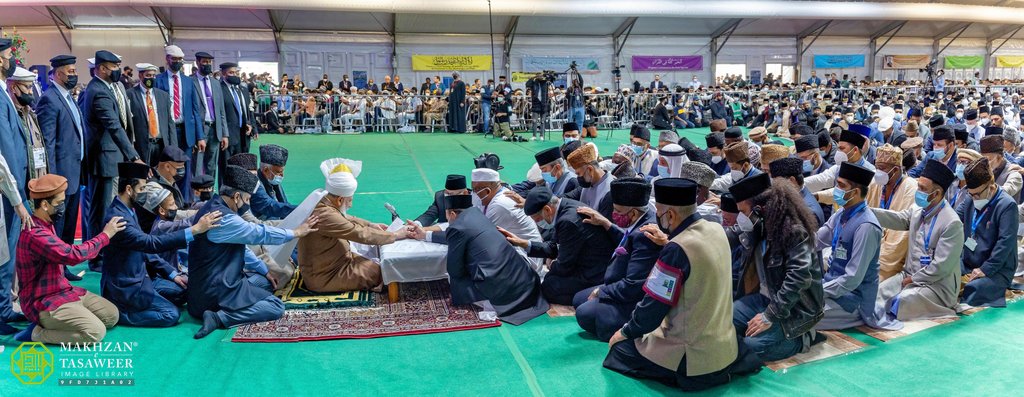
Religious leadership, however, stands upon a far deeper foundation—the pledge of allegiance (Baiʿat), which is not transactional but transformative. When one takes Baiʿat at the hands of a Prophet or Khalifa, it is not merely agreement or membership; it is an act of soul-submission. The believer, through free will, sells himself for the sake of God. Even where personal views differ, the standard remains obedience in what is right (maʿrūf). This is a sacred bond, and turning away from it leads to spiritual ruin.
The Qur’anic Foundation of Baiʿat
The Qur’an enshrines this solemn pledge:
O Prophet! When believing women come to thee, taking the oath of allegiance at thy hands that they will not associate anything with Allah, and that they will not steal, and will not commit adultery, nor kill their children, nor bring forth a scandalous charge which they themselves have deliberately forged, nor disobey thee in what is right, then accept their allegiance and ask Allah to forgive them. Verily, Allah is Most Forgiving, Merciful.
— Surah Al-Mumtahanah 60:13
The key phrase here is “in what is right (maʿrūf)”. Derived from the root meaning “known” or “recognized as good,” maʿrūf in Islamic ethics connotes all that is fair, virtuous, and harmonious with divine law. The Qur’an frequently applies this term, such as in Surah Al-Baqarah 2:179, where it governs justice, compassion, and equity. Thus, obedience in religion is not mechanical-rather, it is a conscious alignment with known goodness as defined by revelation.
Why Baiʿat Is Indispensable
Explaining the necessity and wisdom of Baiʿat, the Promised Messiah (peace be upon him) stated:
“Baiʿat is the practice (sunnah) of the Prophets, and in this practice lie great benefits and wisdom. The greatest benefit is that the bitter and distasteful fruit of a person’s carnal self requires grafting in order to be reformed-and that graft is complete Baiʿat.”
(Narrated by Dr. Syed Abdul Sattar Shah Sahib)
He continued with a vivid analogy:
It is like a tree that bears bitter fruit; to make it sweet, it must be grafted with the branch of a pure and sweet tree. In this way, its fruit also becomes sweet and pleasant. Similarly, by taking Baiʿat at the hand of a pure soul-through that spiritual attention and prayer—the disciple becomes purified and virtuous according to his capacity.
The Promised Messiah(as) further remarked to Maulvi Sher Ali Sahib:
Is it a small benefit of Baiʿat that all of a person’s previous sins are forgiven?
Thus, Baiʿat is not symbolic-it is the mechanism by which spiritual transformation occurs through proximity to divine reflection.
Prophets as Living Signs of God
The Promised Messiah(as) wrote:
Prophets and men of God are necessary for spiritual life until the end of times, consistent with divine design and the attributes of Rabb, Rahman, Raheem, and Maalik. (Barahin-e-Ahmadiyya)
He beautifully described the human ideal:
The word Insān is derived from uns (love, intimacy). Its perfection requires two bonds: one with God through love, and the other with mankind through compassion.
At this level of unity and compassion, one becomes among “ulul-albaab”—those truly endowed with wisdom and moral insight.
The Essence of Righteous Deeds
True righteousness is not achieved through ritual alone but through complete obedience to divine authority. The Promised Messiah(as) declared:
“Righteousness is not achieved by empty declarations, ritual fasts and prayers when these are separated from true obedience and heartfelt belief in the appointed one of God.”(Noah’s Ark)
He warned against selective faith:
“One can say we believe, but many have partial or selective belief in the commandments of Allah and the pronouncements of the Prophet(sa).”
(Malfuzat)
This obedience also manifests in prayer and humility, as the Qur’an commends those “who are humble in their prayers” (23:3).
The Company of the Righteous
The Qur’an further instructs:
“O ye who believe! Fear Allah and be with the truthful.” 9:119
The Promised Messiah(as) explained:
“Without keeping company with the chosen ones of God, hearts remain rusted and deprived of light… it is through the companionship of the righteous that faith is brightened. (Malfuzat)
Conclusion
Secular leadership is based on contract, performance, and the freedom to walk away. Religious leadership, in the Islamic understanding, is based on covenant, transformation, and the soul’s surrender to Allah through His appointed guide
In secular life, leadership governs action; in religious life, it refines the soul. The one addresses efficiency, while the other awakens eternity. One relationship ends at the office door; the other extends into the grave and the Hereafter. The believer’s bond with divine leadership is anchored in Baiʿat, humility, and righteous companionship-all of which cultivate that sweet spiritual fruit of obedience and love toward God.