We are living in distressing times, marked by anxiety, disorder, and a deep sense of uncertainty. While it remains our responsibility to strive within our capacity to alleviate hardship and bring about peace, there is an equally essential need to turn to the Divine for help. True contentment of the heart and meaningful relief from turmoil are not achieved by human effort alone. They require a connection with the One who controls all affairs, whose mercy encompasses every difficulty, and whose power brings order out of chaos.
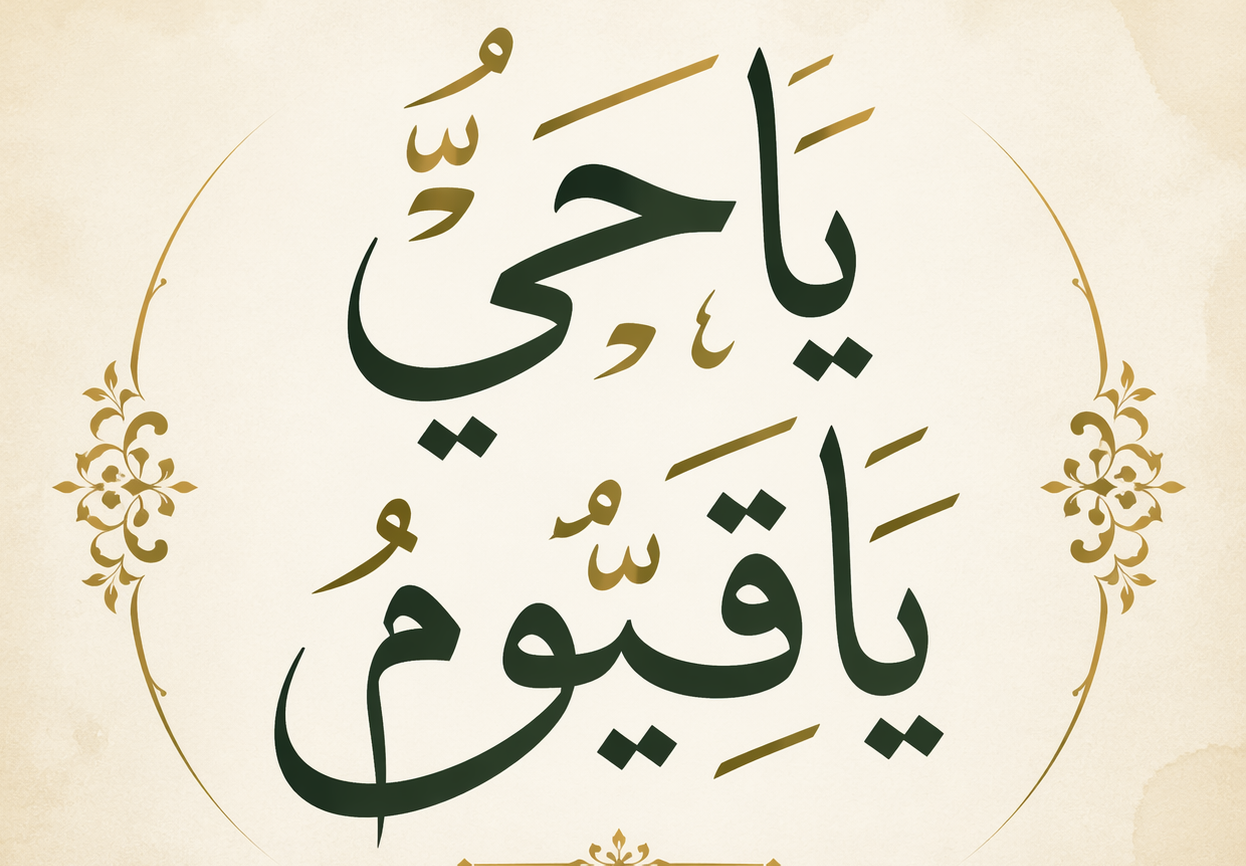
Among the most profound supplications taught for such moments is the prayer;
Yā Hayyu yā Qayyūm, bi-raḥmatika astaghīth, aṣliḥlī sha’nī kullahu, wa lā takilnī ilā nafsī ṭarfata ‘ayn ;
“O Ever-Living, O Self-Sustaining, by Your mercy I seek help; rectify all my affairs and do not leave me in charge of my affairs even for the blink of an eye”
This prayer is highly recommended for seeking Allah’s help in all affairs, especially in times of distress. The Holy Prophet(sa) used this supplication whenever something worried him, and he also advised Hazrat Fatimah(ra) to recite it in the morning and evening. Its consistent recitation reflects a state of humility and dependence, acknowledging that without divine support, even the smallest matter can slip beyond our control.
Central to this supplication are the divine names Al Hayy and Al Qayyum. The Prophet(sa) said:
“Allah has a name such that if invoked in prayer, the prayer is accepted, and if something is asked for it is granted”.
This is the Ism Azam. Accessing its power requires sincerity, purity of heart, and deep surrender to Allah. These two names together cover both the perfection of Allah’s attributes and the perfection of His actions and express the fullness of divine power and mercy. Al Hayy means The Ever Living, the One who never dies and who grants life to all creation. Al Qayyum means The Self Sustaining, the One who sustains all existence and upon whom everything depends. These two names also appear in Ayat al Kursi 2:256; Allāhu lā ilāha illā Huwal Hayyul Qayyūm. Together, they encompass the entirety of existence, both its outward and inward realities.
The Promised Messiah(as) explains in his commentary of this verse that Allah the Exalted has presented these two names as foundational attributes. Al Hayy signifies that He is living in Himself and the source of all life, while Al Qayyum signifies that He stands by Himself and is the true cause of the existence and sustenance of everything else. The outward and inward life of all things depends entirely upon these two attributes. From this understanding emerges a complete spiritual framework. The attribute Hayy calls for worship, as expressed in Surah Al Fatihah in the words “You alone do we worship” (iyyāka na‘budu). The attribute Qayyum calls for seeking help, as expressed in “You alone do we ask for help” (iyyāka nasta‘īn).
The Promised Messiah(as) further illustrates that unlike a builder who constructs a building and then becomes irrelevant to its continued existence, human beings remain in constant need of God at every moment. This perpetual dependence requires that one continually seek strength from Allah, which is the essence of istighfar. The Promised Messiah said that invoking these two names with humility becomes a powerful means of drawing divine assistance, as they encompass the totality of life and sustenance.
Making up for acts of omission and commission is a vital part of spiritual progress. The Promised Messiah(as) says that Istighfar has precedence over repentance, since Istighfar is the seeking of help and strength from God, whereas repentance means standing on one’s own feet. God’s way is that when a person sincerely seeks His help, He bestows strength, which then enables the supplicant to stand firm, repent, and turn back to Him. This is the natural sequence. It is appointed for seekers that they should seek help from God in all conditions, for until a person acquires strength from Him, he can do nothing. The strength for true repentance comes only after Istighfar. Without Istighfar, the faculty of repentance itself dies.
The word astaghīth within the supplication carries profound depth. It is not a casual request but a cry emerging from urgency and helplessness. It conveys a state in which a person, overwhelmed by difficulty, turns to Allah with اsincere dependence, seeking immediate deliverance. It means “I seek help” or “I cry for assistance,” specifically in moments when one feels incapable of managing alone.
This supplication was not merely taught but lived. Hazrat Sahibzada Mirza Bashir Ahmad(ra) relates that Dr Mir Muhammad Ismail Sahib(ra) once described his experience in Qadian during Ramadan in 1895. He observed the Promised Messiah(as) closely in his nightly prayers. He would offer Witr early in the night and later perform eight rakaat of Tahajjud, divided into pairs. In these prayers, he would regularly recite Ayat al Kursi in the first rakaat and Surah Al Ikhlas in the second. During prostration, he would often recite “Ya Hayyu Ya Qayyumu Birahmatika Astaghith” in a voice that could be clearly heard, demonstrating a deep and living connection with this plea for divine help.
In times such as ours, this prayer becomes more than words. It becomes a lifeline. It teaches that while we act, strive, and endure, our ultimate reliance must rest with Allah. Through invoking Al Hayy and Al Qayyum, and through sincerely crying out with astaghīth, we place our affairs in the hands of the One who never fails, seeking not only relief from hardship but a heart anchored in peace and trust.