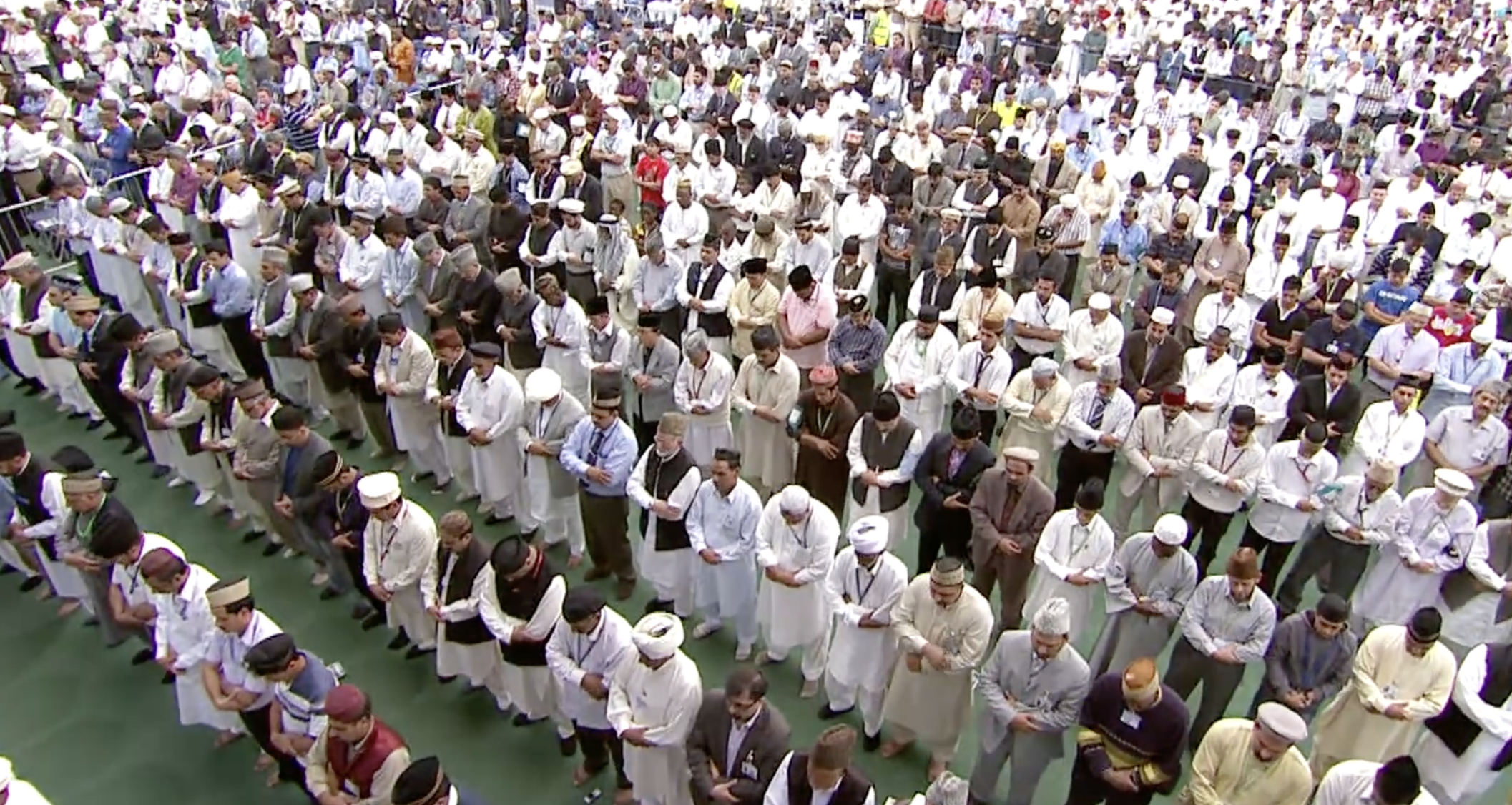
The Holy Prophet(sa) said
“Prayer in congregation surpasses prayer offered individually by twenty-five or twenty-seven degrees.”
Both narrations are found in Sahih al-Bukhari and Sahih Muslim through companions such as Abdullah ibn Umar and Abu Sa‘id al-Khudri(ra). At first glance, the difference between the numbers twenty-five and twenty-seven appears to warrant explanation. Yet, when viewed through the lens of Islamic scholarship, this difference becomes a reflection of nuance rather than contradiction.
Some scholars suggest that the Prophet(sa) initially mentioned twenty-five, then later increased it to twenty-seven upon divine instruction. Others hold that the variation reflects differing circumstances: the sincerity, humility, and concentration (khushu) of the worshipper, the size and spiritual quality of the congregation, or whether the prayer was an audible one such as Fajr, Maghrib, and Isha, or a silent one like Dhuhr and Asr. In either case, the message remains clear, salat in congregation holds immense spiritual merit and forms a cornerstone of communal worship in Islam.
Beyond the precise number lies a deeper meaning. The Prophet’s words are not mere arithmetic but a poetic magnification of divine reward, emphasizing how performing even the most familiar act of devotion collectively strengthens the spiritual bond among believers. A single salat performed in unison with others becomes, in its essence, multiplied in value, as though one had prayed twenty-seven times over. This multiplicity of reward symbolizes the spiritual light that radiates when hearts are united in remembrance of God.
The Promised Messiah(as) affirmed the hadith that Salat offered in congregation carries twenty‑seven times the reward of Salat offered alone, and he invoked this teaching to impress upon Muslims the vital importance of strictly observing all Fard prayers in congregation, rather than becoming occupied with technical discussions about the numerical variation found in different narrations.
Interestingly, across religious traditions, the number twenty-seven holds symbolic resonance. In certain Judeo-Christian interpretations, it represents divine light breaking through darkness, an emblem of the Holy Spirit and compassion. In spiritual or mystical readings, twenty-seven is also seen as a sign of unconditional love and transcendent energy, what some traditions might call a “siddhi” or spiritual gift. In this light, the parallels between sacred numerology and prophetic wisdom underscore a universal truth: communal worship is a source of divine illumination that transforms both the individual and the community at large.
Thus, whether one considers the reward to be twenty-five or twenty-seven, the essence of the teaching remains the same. Salat performed together embodies unity, humility, and the shared experience of divine grace. The number, then, is not mere mathematics but a symbol of abundance, mercy, and collective spiritual upliftment.