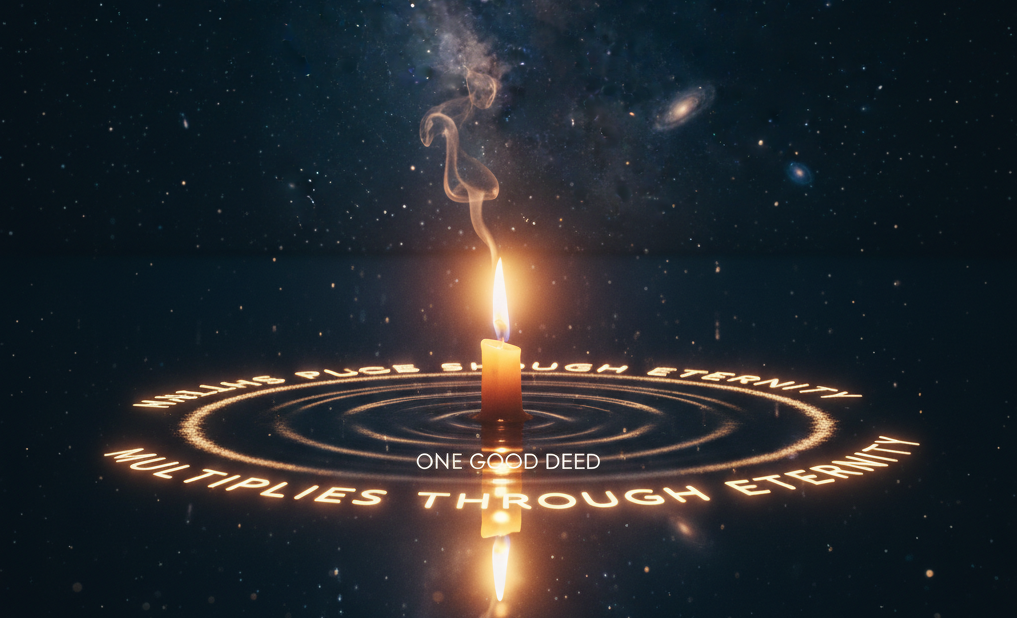
Islam teaches us that good manifests in two complementary dimensions, Khair and Hasanat. Both spring from divine bounty, but they differ in permanence and scope. Khair signifies general good, wellbeing, or prosperity , the things that grant us safety, ease, or advantage in this life. It encompasses material blessings, health, peace, and worldly success. The Holy Qur’an says:
“My Lord, I am in need of whatever good Thou mayest send down to me.” (28:25)
and again, the believer’s encompassing prayer is:
“Our Lord, grant us good in this world as well as good in the world to come, and protect us from the torment of the Fire.”(2:202)
Here, Khair relates to the temporal benefits that make life wholesome and fulfilling. As Allah reminds us, these worldly gifts are fleeting:
“And whatever you have been given is only a temporary provision of this life, but that which is with Allah is better and more lasting for those who believe and put their trust in their Lord.” (42:37)
“And whatever of the things of this world you are given is only a temporary enjoyment of the present life… and that which is with Allah is better and more lasting. Will you not then understand?” (28:61)
Hasanat, on the other hand, refers to enduring good, the lasting effects of righteous deeds that accumulate as spiritual capital. These are the deeds which will be weighed on the Day of Judgment. The Qur’an distinguishes between transient good and everlasting reward:
“Whoso desires the harvest of the Hereafter, We give him increase in his harvest; and whoso desires the harvest of this world, We give him thereof, but in the Hereafter he will have no share.” (42:21)
Those whose efforts are directed only toward worldly gain lose out on the enduring bliss of the Hereafter. But for those who labor for Hasanat, their good multiplies and follows them beyond death – “Divine blessings bestowed upon them without measure and diminution.”
If we review the Prophetic and Spiritual Models of Hasanat we find The Holy Prophet Muhammad(sa) was the supreme model of Hasanat , every act of his life created good that endures through generations:
“Verily you have in the Prophet of Allah an excellent model, for him who fears Allah and the Last Day and who remembers Allah much.” (33:22)
Similarly, the Qur’an presents Abraham(as) as one whose righteousness continues to bear fruit:
“There is a good model for you in Abraham and those with him.”(60:5)
“Surely, there is a good example in them for you, for all who have hope in Allah and the Last Day.” (60:7)
The Prophet(sa) said:
“When a person dies, his deeds come to an end except three: continuing charity (sadaqah jariyah), beneficial knowledge, or a righteous child who prays for him.”(Sahih Muslim, Kitab al-Wasiyyah)
This ḥadīth perfectly captures the essence of Hasanat , good that reverberates long after our earthly life ends.
Hazrat Mirza Tahir Ahmad(rh), Khalifatul Masih IV, beautifully explained the interplay between Khair and Hasanat. He noted that Khair represents the goodness visibly experienced in this life , a reflection of God’s mercy that sustains and beautifies existence. Yet Hasanat, he said, is “the fruit of faith,” a spiritual currency that accumulates through selfless deeds done for Allah’s sake.
He explained that every righteous act may begin as Khair ,a good deed or blessing , but only becomes Hasanat when the intent behind it is pure and directed toward earning Allah’s pleasure. Thus, “Khair becomes Hasanat when goodness transcends self-interest and aligns with divine purpose.”
As the Qur’an declares:
“Whoso desires the Hereafter and strives for it as he ought to strive for it, and he is a believer — then it is these whose striving shall find favor with Allah.”(17:19)
“To all — these as well as those — We give of the bounty of thy Lord. And the bounty of thy Lord is not confined.” (17:20)
In this spirit, true believers balance Khair and Hasanat: they seek the good of this world while sowing seeds of eternal good in the next. Ultimately, everything that endures, everything that blossoms long after the deed itself is done ,that is Hasanah, the lasting good that Allah causes to multiply in the fields of the Hereafter.